
Mostrando entradas con la etiqueta SCIENCE. Mostrar todas las entradas
Mostrando entradas con la etiqueta SCIENCE. Mostrar todas las entradas
lunes, 11 de enero de 2021
domingo, 13 de diciembre de 2020

lunes, 7 de diciembre de 2020

lunes, 30 de noviembre de 2020


viernes, 20 de noviembre de 2020


domingo, 1 de noviembre de 2020


domingo, 25 de octubre de 2020


domingo, 18 de octubre de 2020


martes, 13 de octubre de 2020
Planificación semanal de INGLÉS Y SCIENCE. De 13 a 16 de octubre.
Hola a todos/as,
Aquí tenéis la planificación de esta semana de Inglés y Science para el alumnado que se queda en casa.
Planificación semanal de INGLÉS
Y SCIENCE. De 13 a 16 de octubre. 3º
Primaria. Curso 20/21
ACTIVIDADES PREVISTAS PARA EL
ALUMNADO QUE TRABAJA EN CASA
|
LUNES |
MARTES |
MIÉRCOLES |
JUEVES |
VIERNES |
|
SCIENCE |
INGLÉS |
SCIENCE |
INGLÉS |
SCIENCE |
|
Festivo |
Libro: Pág. 8, actividad 3
(oral), página 9, actividades 1, 2, 3 (oral) Cuadernillo: páginas 6 y 7. |
Powerpoint
“Matter”: Leeremos las seis primeras diapositivas. Este material está en
Google Classroom. Realizaremos en
el cuaderno la actividad 3 de la página 7 del libro y la actividad 3 de la
página 9. |
Libro: Pág. 10, actividades 1
y 2 (oral). Cuadernillo: Páginas 8 y 9. Libro: Pág. 11, actividades 1
y 2 (oral) Cuadernillo: Pág. 10. |
Powerpoint “Matter”: Repasaremos las seis primeras
diapositivas y, además, leeremos las diapositivas 8 y 9. Realizaremos en el cuaderno las actividades 3 y 4 de la
página 13 del libro. |
|
ALUMNOS QUE FALTAN |
||||
|
Elena –
Isabel – Candela – Iván - Daniel |
Ricardo –
Ianira – Alba – Eliezer – Aya |
Zhao –
Salomon – Adam – José Manuel |
Jose –
María Espín – María Tomás – Érik – Kevin |
Clara –
Carla – Ana – Jesús - Juan |
|
ALUMNOS QUE SE TIENEN QUE LLEVAR LIBROS DE… |
||||
|
Ricardo –
Ianira – Alba – Eliezer – Aya |
Zhao –
Salomon – Adam – José Manuel |
Jose –
María Espín – María Tomás – Érik – Kevin |
Clara –
Carla – Ana – Jesús - Juan |
Elena –
Isabel – Camdela – Iván – Daniel |
|
ACTIVIDADES DIGITALES DE APOYO |
||||
|
|
Days of the week https://www.youtube.com/watch?v=LIQsyHoLudQ Months of the year https://www.youtube.com/watch?v=lPeAo1hz8GA The four seasons https://www.youtube.com/watch?v=_0zKV6j1MDg&list=PLqz8eAhunKbsXY8YH2AjQ5aWwYeOh_V2i&index=4&t=0s (Autumn=Fall) Weather https://www.youtube.com/watch?v=RmSKsyJ15yg Numbers https://www.youtube.com/watch?v=e0dJWfQHF8Y |
|||
|
SCIENCE |
Properties of materials https://www.youtube.com/watch?v=340MmuY_osY Physical and chemical changes https://www.youtube.com/watch?v=BgM3e8YZxuc Homogeneous o heterogeneous mixture? https://www.youtube.com/watch?v=7chCv6YcEms |
|||

jueves, 24 de septiembre de 2020
INGLÉS Y SCIENCE
Hola a todos/as,
Aquí tenéis los enlaces para acceder a las aulas virtuales de Google Classroom de Inglés y Science de 3º.
-INGLÉS: https://classroom.google.com/c/MTQ1NDU4MjkzMjQ2?cjc=hzfgkrt
-SCIENCE: https://classroom.google.com/c/MTQ1NDU4MjkzMjU5?cjc=nkqjuma
Un saludo y ¡bienvenidos/as!
miércoles, 10 de junio de 2020
SOCIALES Y SCIENCE
¡Hola chicas y chicos!
Dado que nos estamos acercando al final del curso, hoy os propongo las últimas actividades de todas las asignaturas para que os organicéis como mejor os venga.
En esta entrada os dejo las tareas de sociales y Science.
En esta entrada os dejo las tareas de sociales y Science.
Además aprovecho para recordaros que vayáis revisando que no os queda nada por entregar, no sólo de lengua, matemáticas, Science, inglés... sino también de música o educación física. Si tenéis dudas de si habéis entregado o no las tareas propuestas, poneros en contacto con los maestros a través del formulario habilitado en la página web del colegio.
SOCIALES
"El lugar en el que vives"
Asómate a la ventana y dime ¿qué ves?:
- ¿Vives en un barrio antiguo o un barrio moderno? ¿Por qué lo sabes?
- ¿Cuántos elementos visibles puedes ver desde tu ventana?
- ¿Puedes ver algún elemento oculto?
- ¿Ves alguna señal de tráfico? ¿Cómo es? ¿Qué significa?
Podéis adjuntar una foto junto a vuestro trabajo para que yo también pueda ver lo que veis desde vuestras ventanas.
Para hacer este ejercicio podéis revisar la unidad 4 de tu libro de sociales.
SCIENCE
We are going to review the nutrients in food.
Open your class book at page 28/29. (Unit 4) Read and then do the interactive worksheet.
jueves, 4 de junio de 2020
SCIENCE
GOOD MORNING CHILDREN!
Today we are going to remember the digestive system.

Our digestive system help us to get the nutrients we need from food.
Do this interactive worksheet.
Today we are going to remember the digestive system.

Do this interactive worksheet.
Our systems 3º, una ficha interactiva de LuzMariaNavarro
liveworksheets.com
liveworksheets.com
lunes, 1 de junio de 2020
SCIENCE
GOOD MORNING KIDS!!
Starting a new month!! It´s JUNE!!


Do these interactive worksheets.

Respiratory system
Write
Starting a new month!! It´s JUNE!!
Today we are going to continue with the respiratory and the circulatory systems.
Respiratory system

Oxygen enters our blood through the respiratory system when we breathe in. Then, the carbon dioxide we don´t need leaves our body when we breathe out.
It is made up of the nostrils, the trachea, the bronchi and the lungs.
Circulatory system

It is carries nutrients from the food we eat and oxygen from the air we breathe around the body. It is made up of the heart, blood and blood vessels.
Do these interactive worksheets.
Respiratory system
Accede a la ficha interactiva picando en el siguiente enlace:
Circulatory System, una ficha interactiva de bmeca
liveworksheets.com
liveworksheets.com
jueves, 28 de mayo de 2020
SCIENCE
Today we are going to remember our locomotor system.


Let´s
go to refresh your memory!!
Now, do this interactive worksheet.
lunes, 25 de mayo de 2020
SCIENCE
GOOD MORNING KIDS!
These weeks, we are going to remember our body systems.
Let´s go to start with our nervous system.

Watch the videos and then, do the interactive worksheets.
These weeks, we are going to remember our body systems.
Let´s go to start with our nervous system.

Watch the videos and then, do the interactive worksheets.
The nervous system, una ficha interactiva de lorenadiaz87
liveworksheets.com
H A P P Y M O N D A Y !
liveworksheets.com
Aclaración:
Lee bien los enunciados de los ejercicios. ¿Qué te pide que hagas? Si tienes que leerlos más de una vez, no pasa nada. Vuelve a leerlos y ten claro lo que te pide: escribir, elegir una opción, unir, arrastrar hasta el lugar correcto,...
Todo lo que aparece en la ficha lo hemos visto. Confiad en vosotros que lo vais a hacer genial.
H A P P Y M O N D A Y !
jueves, 21 de mayo de 2020
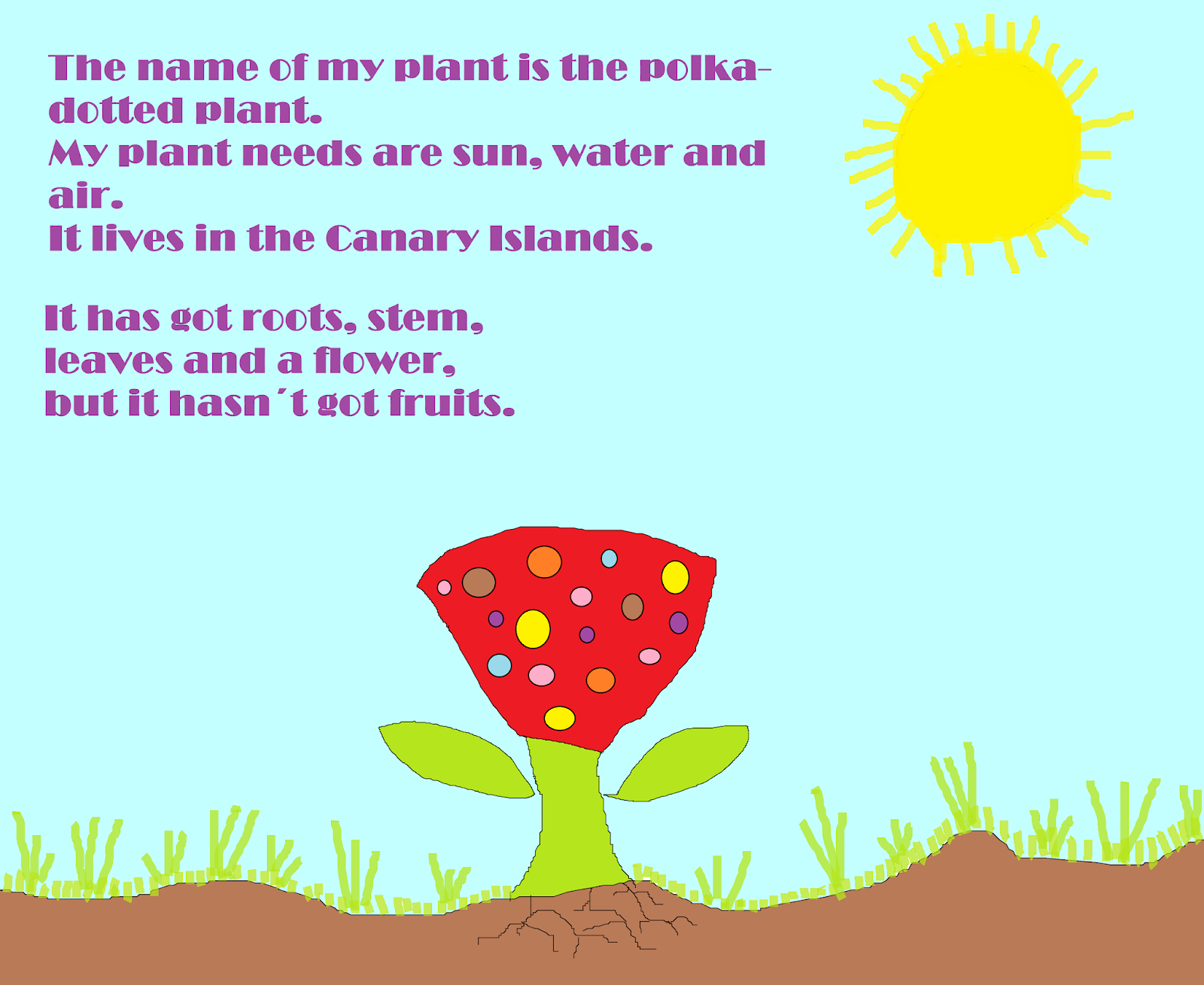
lunes, 18 de mayo de 2020
SCIENCE
Good morning boys and girls!
Let´s go to start the week remembering the types of plants.
Plants can be classified by their stem and by their leaves.
If we take into account their stem, we can find three big groups:

According to their leaves, we can find two big groups: evergreen and deciduous.
- Evergreen: plants always have leaves because they make leaves all year.
- Deciduous: plants lose their leaves in autumn. New leaves grow in spring.
Do the exercises 1, 2 and 3 on the interactive worksheet:

Haz clic en el enlace para acceder:
jueves, 14 de mayo de 2020
SCIENCE
PLANT REPRODUCTION AND NUTRITION
REPRODUCTION
All plants do the life process of reproduction. Flowering plants reproduce by making seeds inside their flowers. Flowers have a male and a female reproductive organ inside.
Click on the different icons to discovered the parts of a flower.
(Pica encima de los diferentes elementos interactivos (símbolo de la suma y el icono del vídeo) para descubrir las partes de una flor)
WHAT IS POLLINATION?
Pollination is the act of transferring pollen from the male organ (stamen) to the female organ (pistil) of a flower.
Flowers are the tools that plants use to make their seeds.

Pollination is the act of transferring pollen from the male organ (stamen) to the female organ (pistil) of a flower.
Flowers are the tools that plants use to make their seeds.
How does pollen get from one flower to another?

NUTRITION
Plants make their own food through a process called photosynthesis.
Plants make their own food through a process called photosynthesis.
Photosynthesis
minerals + water + sunlight + carbon dioxide = food + oxygen.
ACTIVITIES:
- Activity 1. Draw a flower and write the name of its parts. Colour the corolla in red, the sepals green, the stamens orange and the pistil yellow.
- Activity 2. Play the game.
lunes, 11 de mayo de 2020
SCIENCE
Good morning!!!
These weeks we are going to remember the topic of plants.
As you know, plants are living things. They are born, grow, reproduce and die.

They need water, air, sunlight and minerals. They make their own food. They can´t move.

Plants have roots, stems and leaves. These have differents functions. Watch this video and remember them.
NOW, DO THESE INTERACTIVE WORKSHEETS:
Parts of a plant, una ficha interactiva de victor
liveworksheets.com
liveworksheets.com
Plants, una ficha interactiva de _anamez
liveworksheets.com
liveworksheets.com
lunes, 4 de mayo de 2020
SCIENCE
ENDANGERED ANIMALS
Endangered animals are species that are at risk of becoming extinct.
(Recomiendo que os descarguéis el documento en vuestro ordenador. Es una presentación de power point)
MISSION: ANIMAL RESCUE
How you can help save animals?
Instrucions:
- Choose one animal.
- Find out:
- Where it lives.
- How it reproduces.
- If it is a vertebrate or invertebrate.
- What covers its body (fur, shell, feathers....)
- What it eats.
- Why it´s endangered.
- Finally, create a lapbook.
You will have to send me a video in which you show me your lapbook.
You will have to send me a video in which you show me your lapbook.
For example:

Aclaración:
Os he puesto varios vídeos, pero no es obligatorio verlos todos.
Además, aprovecho para deciros que como esta tarea os va a llevar más tiempo, el jueves no mandaré nada nuevo de Science.
Tenéis hasta el lunes 11 de mayo para entregarme los vídeos.
Suscribirse a:
Entradas (Atom)